Turn a UI reference into a brief your agent can follow.
"Make this card look like the reference" leaves the agent to guess which part you care about. Say which decisions you're borrowing, put the real content in the brief, say what you don't want, and check the result against the brief as well as the screenshot. When something is off, point to that mismatch instead of asking for more polish.
Why a screenshot isn't a brief
"Make this card look like the reference." I'd want to be more specific before sending that. The agent could copy the decoration, pick up the wrong detail, or give me a card that looks similar but doesn't fit the content.
The screenshot doesn't tell it which part I actually care about.
Say which part you're borrowing
The reference here is a feature tile from Kestrel, my own fictional demo. Its heading says "A thousand runs, one queue", and the paragraph explains that tasks wait and workers take them as they become free.
I'm borrowing one thing from it: the relationship between a short title and its explanation. The new card is for a separate, made-up project board. I'm not copying the illustration, and they aren't the same product.
Use the real words
On the new card, someone should recognise a task and see which board it belongs to. The task is "Review homepage copy". The board is "Website refresh". Those are the actual words the layout has to handle, so they go in the brief before I ask for a design.
Otherwise I'm judging a tidy card full of placeholder text, and the real title may wrap completely differently.
What to keep, and what to leave out
Then I describe what to keep from the reference:
- Keep the title and the explanation together as one unit.
- Use the preview to show the task being described, not an unrelated illustration.
- Make the task title the main label, and keep the board name nearby.
- If the task title wraps onto a second line, the board label still sits with it, so the two are read together.
And what I don't want:
- Don't bring over Kestrel's branding.
- Don't add a fake activity graph.
- On a narrow screen, put the preview below the text rather than squeezing both into tiny columns.
- Keep the whole task title visible. If space gets tight, let the card grow.
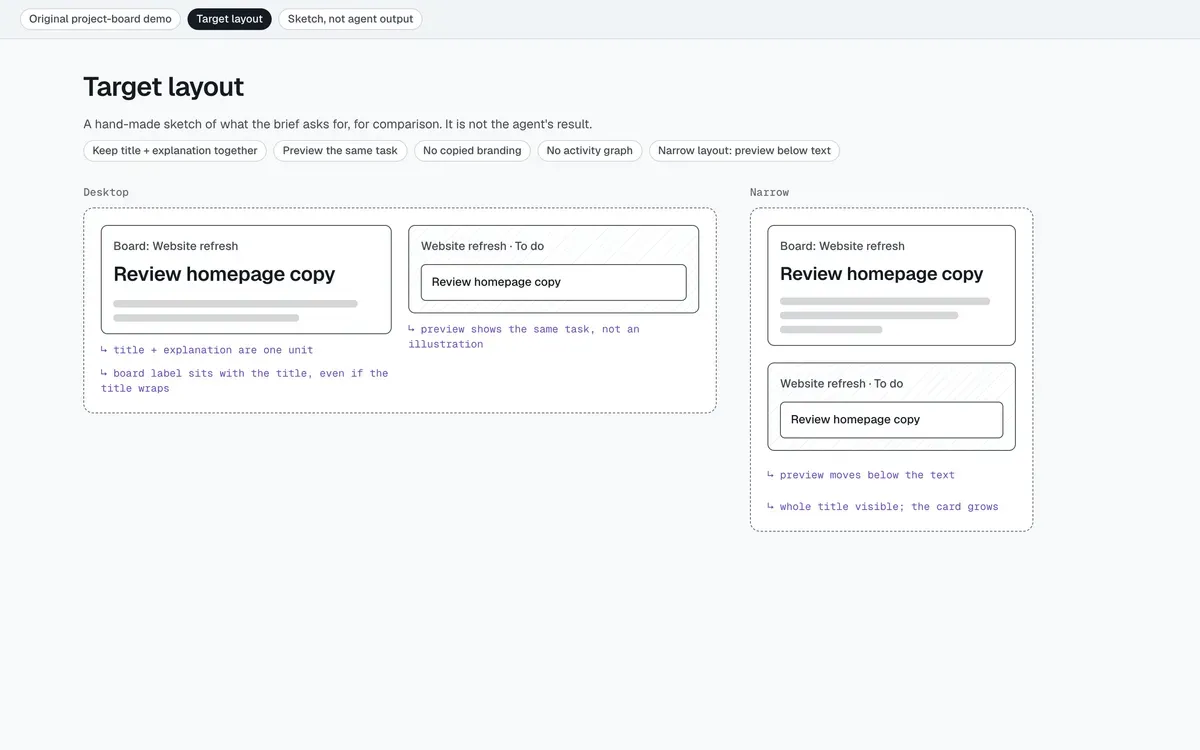
 What the brief asks for
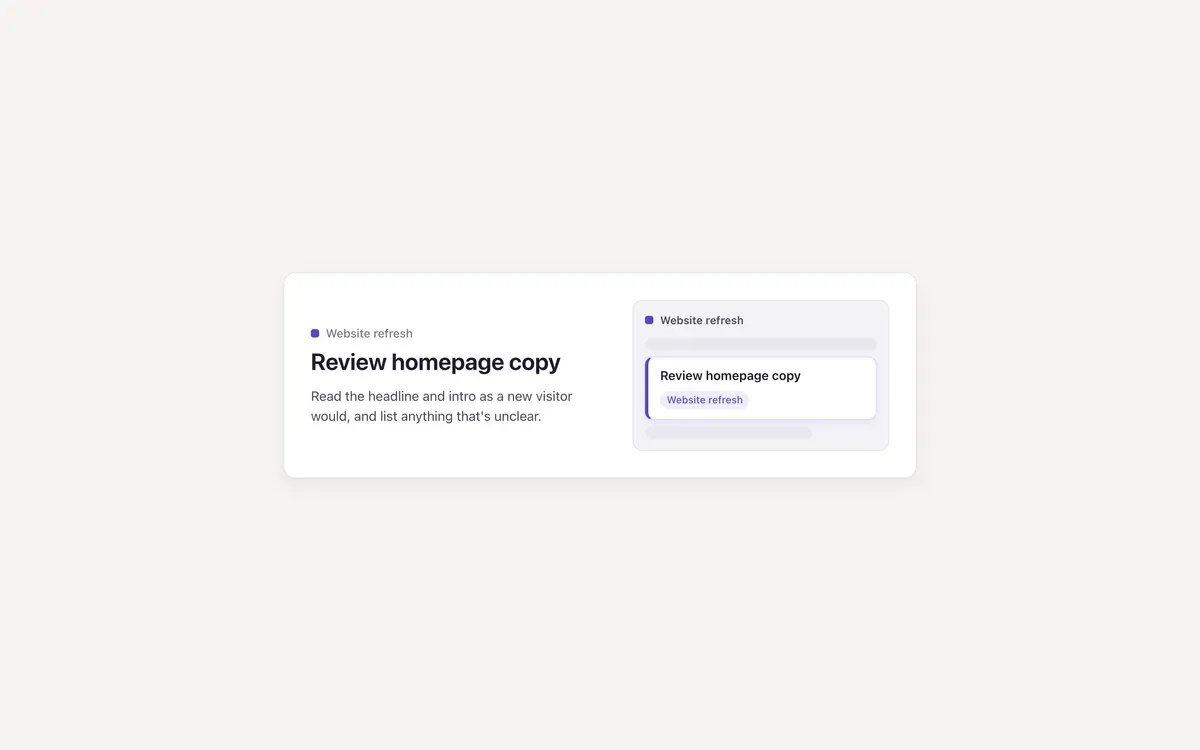
 What the agent made
Check the result against the brief
When the agent gives me a result, I compare it with the brief as well as the screenshot:
- Can I read Review homepage copy without opening anything?
- Is Website refresh clearly the board, rather than another task?
- Does the preview show that same task?
- Does the narrow version still work?
A result can resemble the reference and still fail the thing I asked it to do.
A more useful next message
If it does fail, I point to that mismatch instead of asking for more polish:
- "The task title is cut off here; let this area wrap."
- "This graph wasn't in the brief; remove it and keep the task preview."
You don't need to invent a new style every time something is wrong. Start with a reference you own, tell the agent which decisions you're borrowing, and keep the real content in the comparison. Then you've got something specific to review when the result comes back.
Illustrations your agent can keep in one style
I make Illos: animated illustrations for product sites, and skills that teach your coding agent each theme's rules, so the illustrations it makes match the ones you have. More on how skills work in agent skills for design. The 79 spot illustrations are free, with no account.
Browse free illustrationsQuestions
Anything else? Write to hello@illos.dev.
Can I give a coding agent a screenshot as a design reference?
Yes, but say which part you're borrowing. A screenshot alone doesn't tell the agent whether you care about the layout, the decoration or one detail.
Should a design brief use placeholder text?
No. Put the real words in, because a real title may wrap differently from placeholder text.
How do I check what the agent made?
Against the brief as well as the screenshot: can you read the real content, is each label clearly what it should be, and does the narrow version still work?
What should I say when the result is wrong?
Name the mismatch, such as a title that's cut off or a graph that wasn't in the brief, rather than asking for more polish.